Rewilding the upper Klamath River Basin: rapid recolonization of Chinook salmon following the world’s largest dam removal
By Damon H. Goodman, Keith Denton, George R. Pess, James Whelan. Oleksandr Stefankiv, Toz Soto, Alex Corum, Jordan Ortega, Oshun O’Rourke, Mark E. Hereford, Domenic Giudice & Nicholas A. Som
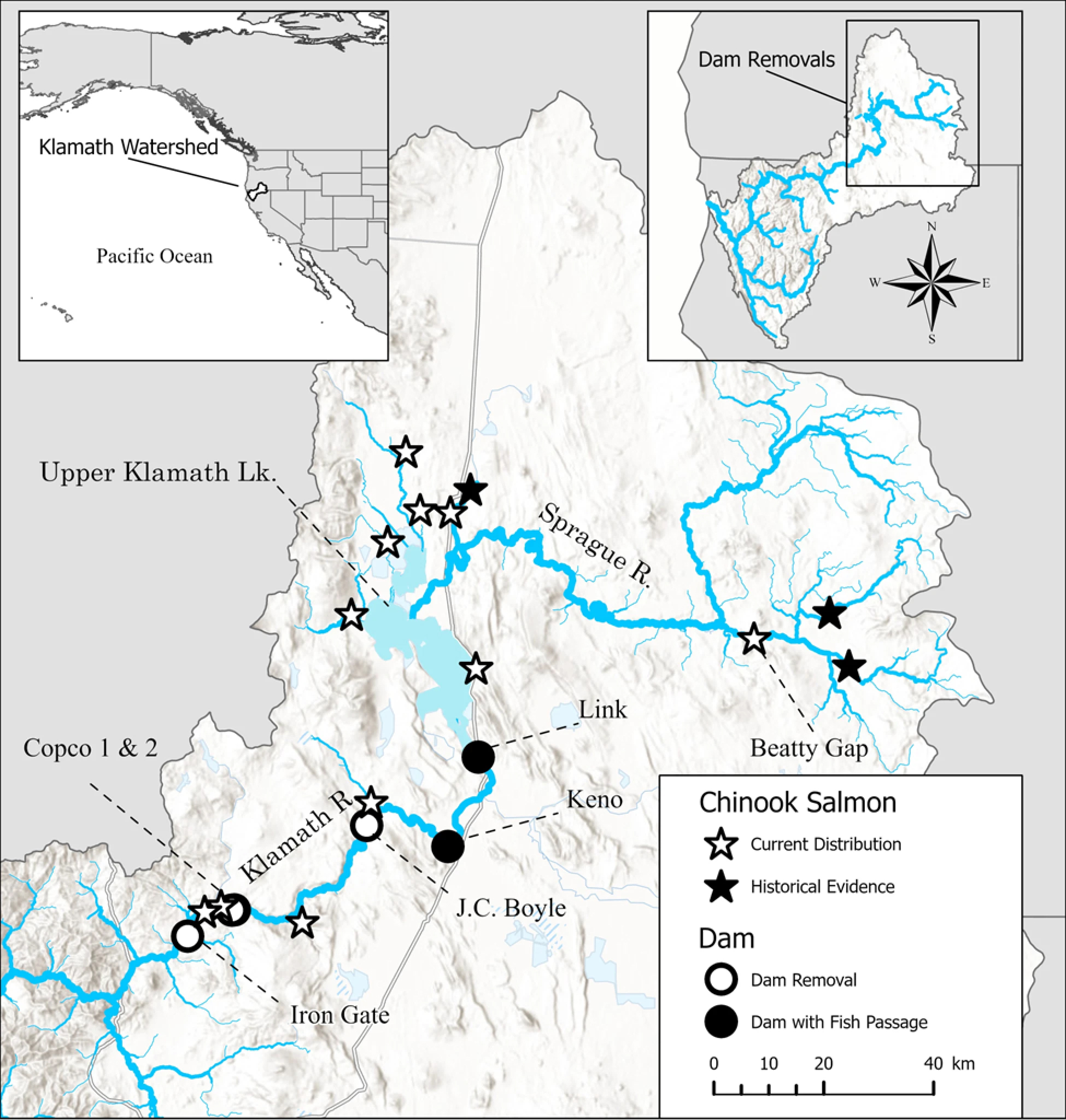
Habitat fragmentation is a global driver of decline in biodiversity, yet evaluations of ecological response following re-connection remain rare. In 2024, four hydroelectric dams on the Klamath River were removed, reconnecting over 640 km of anadromous habitat and marking the largest dam removal project completed to date. We used a stationary high-resolution multi-beam imaging SONAR to quantify adult Chinook salmon (Oncorhynchus tshawytscha) passage into newly reopened reaches during the first two migratory seasons following dam removal. An estimated 7,742 (95% CI: 7,702–7,778) Chinook salmon migrated upstream in 2024 and 13,310 (95% CI: 12,876–13,733) in 2025, representing 18–19% of fish returning to the Klamath River Basin. Within this period, Chinook salmon recolonized 88% of their documented historical distribution, expanding into 345 km of reconnected habitats and reaching elevations of up to 1,250 m. Recolonization required fish to swim through dam removal sites, complex hydraulic corridors and engineered fishways, demonstrating the propensity for rapid recolonization at basin scale despite these challenges. These findings provide the first quantitative assessment of salmon response to the world’s largest dam removal and demonstrate how reconnection can catalyze large-scale recolonization in historically fragmented river networks.
Habitat fragmentation and associated impacts are primary drivers of global biodiversity decline and ecosystem dysfunction1. Fragmentation can cause the non-random loss of species important for ecosystem function, or restrict individual movement among sites, limiting the adaptive capacity of populations to climate vulnerability (1,2)
Impacts of habitat fragmentation can extend to human communities by reducing the benefits of ecosystem services (3). Reconnecting fragmented habitats is a widely applied strategy to enhance ecosystem resilience, restore species, and support human well-being (4–6). Demonstrated benefits of large scale reconnection projects are emerging across terrestrial, marine, and freshwater ecosystems with evidence of recovery as migratory behavior resumes, animals expand their distributions and lost ecosystem processes re-establish (7–9). Reestablished animals can change the trophic structure of ecosystems, allow for range expansion, and promote long-term species population recovery (6,10,11). For example, protection, range expansion, and increased connection between important habitats in Mozambique’s Parque Nacional da Gorongosa has helped to increase large-mammal biomass since war ended in 2004 (12). Connectivity is now recognized as foundational to restoration in marine ecosystems13. Large-scale reconnection projects remain rare – hindering our ability to learn from and predict ecological outcomes in fragmented ecosystems. (7)
River networks provide a framework for reconnecting ecosystems via their linear topology and the discrete nature of anthropogenic barriers (14). The connectivity of river networks is vital to human wellbeing, ecosystem resilience, and biological diversity (14–16). River connectivity is the basis for restoring and recovering river systems and associated freshwater populations of animals including salmonids (14,17,18). If connectivity is lost due to a barrier or set of barriers, restoring connectivity then allows for re-expression of ecological processes
1) California Trout, San Francisco, CA, USA. 2) Keith Denton and Associates, Sequim, WA, USA. 3) George Pess Consulting, Seattle, WA, USA. 4) Karuk Tribe, Orleans, CA, USA. 5) Klamath Tribes, Chiloquin, OR, USA. 6) Yurok Tribe, Klamath, CA, USA. 7) Oregon Department of Fish and Wildlife, Klamath Falls, OR, USA. 8) California Department of Fish and Wildlife, Yreka, CA, USA. 9) U.S. Geological Survey California Cooperative Fish and Wildlife Research Unit, California State Polytechnic University, Humboldt, Arcata, CA, USA.
email: dgoodman@caltrout.org
Scientific Reports | (2026) 16:25322
https://doi.org/10.1038/s41598-026-65437-0www.nature.com/scientificreports