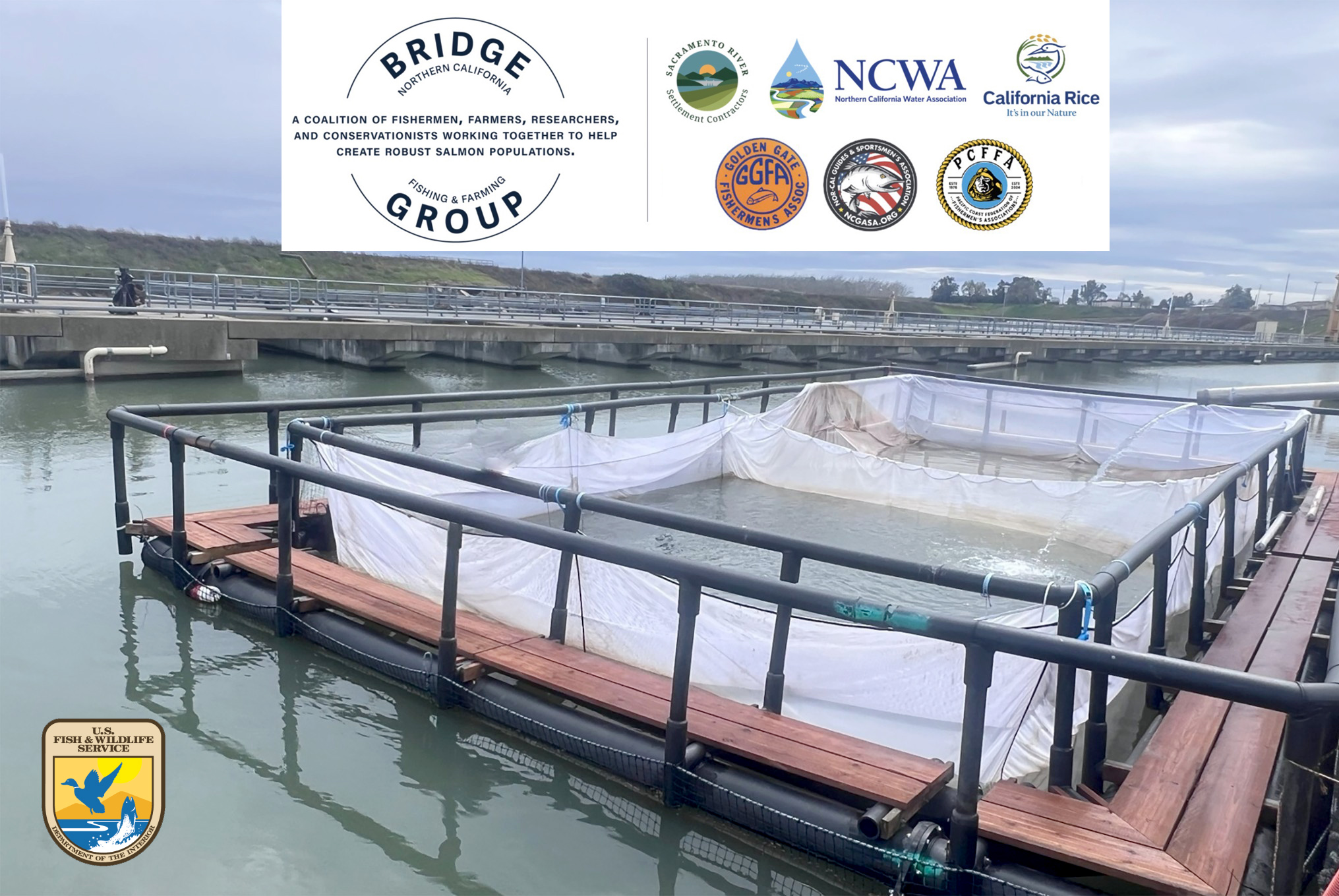
The Bridge Group’s Salmon Projects in partnership with Coleman Fish Hatchery
Year two of the Net Pen Project is officially underway!
Friday, Feb. 27, 2026 from Coleman National Fish Hatchery
Red Bluff, CA — More than 400,000 juvenile fall Chinook salmon made the trip from the hatchery to net pens near Red Bluff. This collaborative effort between the hatchery and the Bridge Group is helping us study how raising salmon downstream of the hatchery, on the mainstem Sacramento River, affects their survival and return rates.
Half of the fish will be released directly into the river at Red Bluff, while the other half will be transported to the Delta for release.
Each fish has been marked with an adipose‑fin clip, a coded‑wire tag, and genetically identified through PBT (parental based tagging).
As these fish return as adults, we’ll be able to compare survival and spawning patterns between the two release groups, plus we will be able to compare these groups against fish released directly form the hatchery as fed fry (smaller fish released in the winter) or smolts (larger fish released in the spring).
Visit Coleman National Fish Hatchery for more info., or read more about all the salmon recovery projects the Bridge Group is working, visit on our News Blog.
Other Bridge Group projects
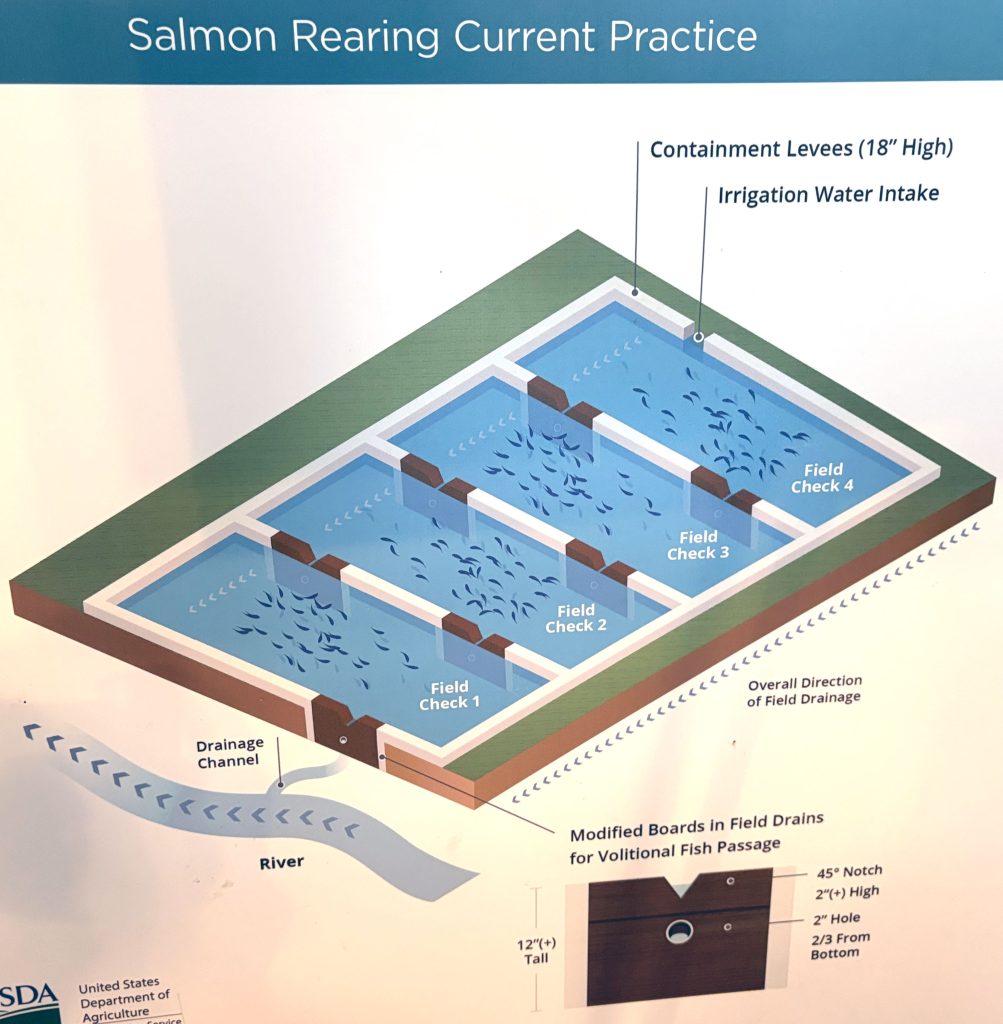
fish on the floodplains / Rice Field Projects
Bridge Group establishing creative solutions for salmon restoration by collaborating with a unique set of organizations
From Western Outdoor News and featured in Fish Bio News
MARYSVILLE – Finding solutions to complex problems often requires a different level of creativity, and the continued decline of California’s salmon populations has required thinking ‘outside the box.’ A unique group of partners consisting of fishermen, farmers, scientists, and water managers have been putting their heads together to develop an action plan in the attempt to restore salmon. The Nor-Cal Guides and Sportsmen’s Association (NCGASA), Golden Gate Fishermen’s Association (GFFA), Pacific Coast Federation of Fisherman’s Association, California Rice, Northern California Water Association, and Sacramento River Settlement Contractors have formed a collaborative working group to form the Northern California Fishing and Farming Bridge Group.
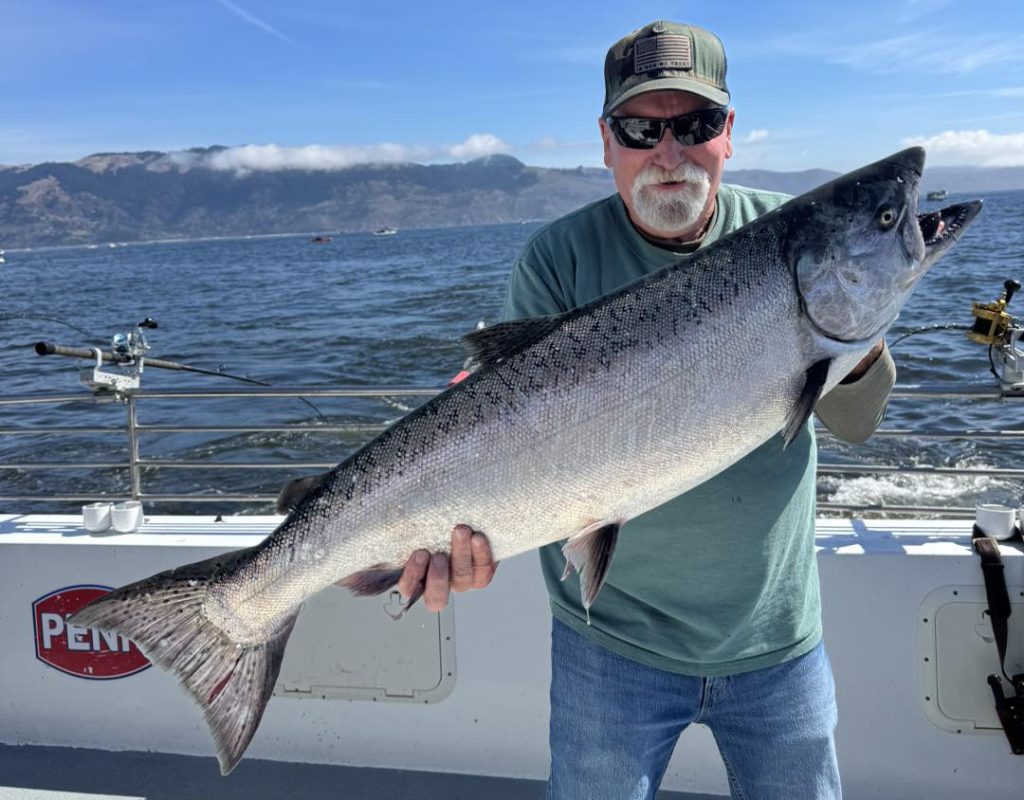
Captain James Smith of California Dawn Sport Fishing and the GFFA has been a member of the group since its inception, and he is extremely enthusiastic about transitioning the ‘farmers vs. fishermen’ scenario from one of conflict to one of cooperation.
The group recently was the catalyst for a release of 1.8 million salmon fry from the U.S. Fish and Wildlife’s Coleman Hatchery into winter-flooded rice fields near Sacramento. According to the Bridge Group’s press release, research from UC Davis ‘demonstrates how rice fields provide vital ecological benefits by mimicking historical floodplain environments young salmon once relied upon while migrating to the ocean. Simply put, salmon feeding on zooplankton in intentionally flooded farm fields bulk up – often growing two to five times faster than in rivers, giving them the size and strength needed to improve their chance of reaching the Pacific Ocean.”
This first release is part of a plan to annually release 2 million salmon fry into flooded rice fields over the next decade, and it is only one of several projects in process by the group including a new hatchery on the Sacramento River.
With commercial salmon fishing closed and recreational fishing limited to a six-day ocean season since 2022, all hands must to be on deck to find creative solutions to bring back California’s salmon population. Water diversions through the California Delta continue at a increased pace, leaving the only answers for stakeholders to collaborate with each other and try new approaches. When the seasons are open, Sacramento River salmon generate over $2 billion in economic activity for communities in California and Oregon, providing approximately 23,000 jobs in California and nearly half that number in Oregon. In addition, California’s salmon are a critical food source for orcas, sea lions, harbor seals, and sharks. The stakes for salmon survival are very high.
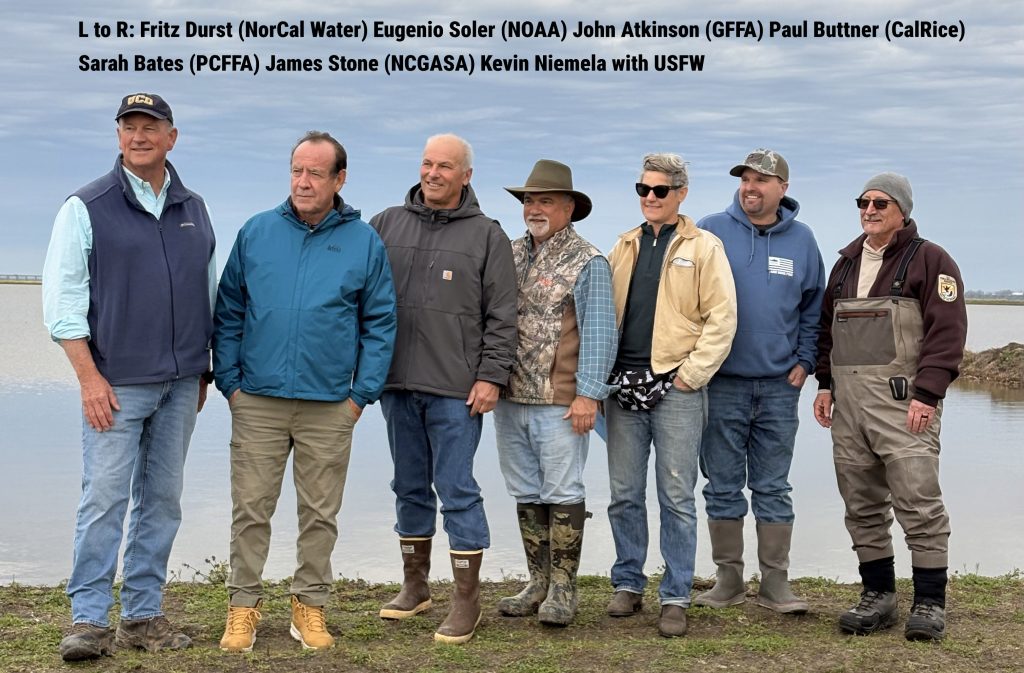
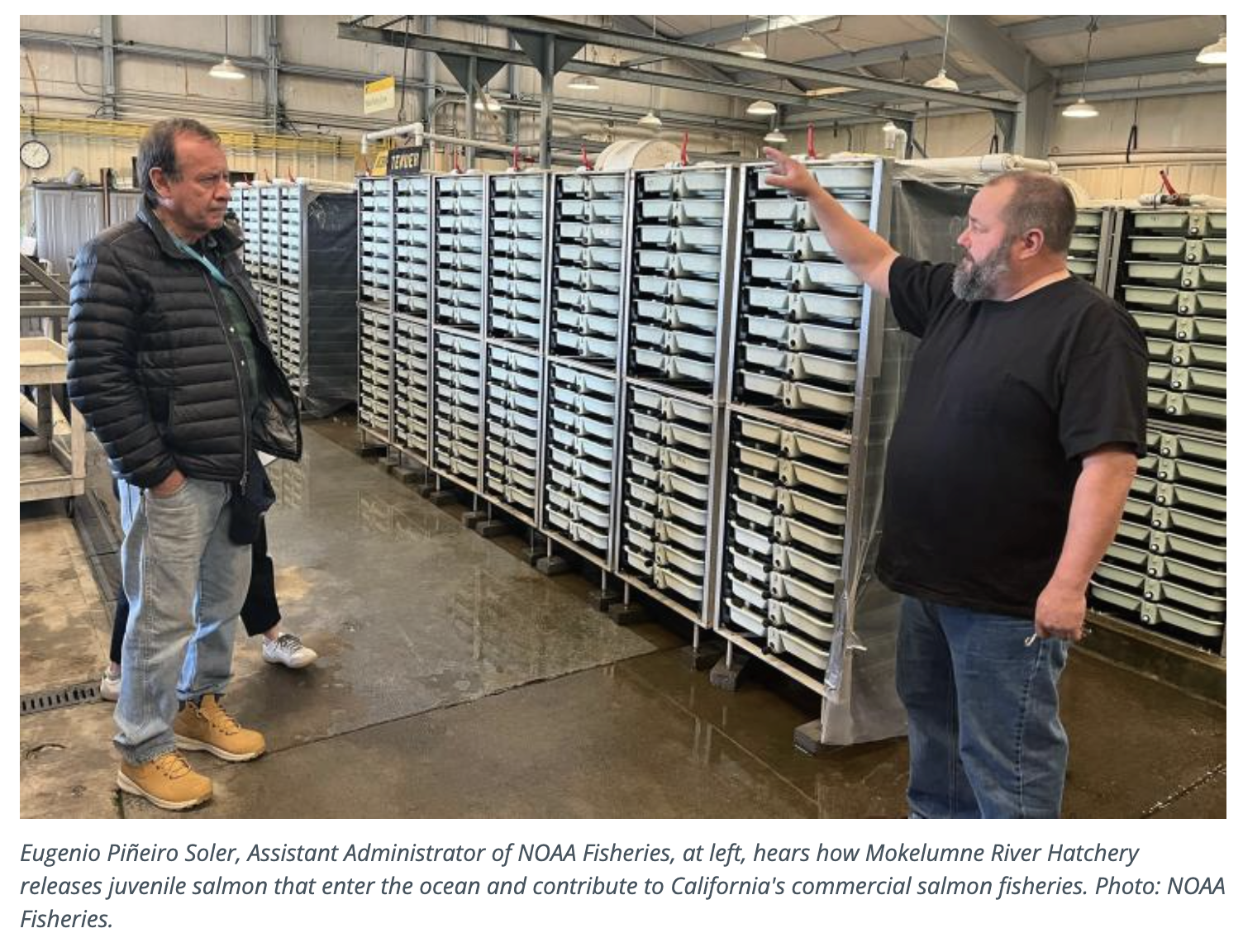
On a recent tour of salmon fry in the rice fields at Conway Ranch, the Bridge Group along with the Assistant Administrator of Fisheries Eugenio Piñeiro Soler posed for a photo. Subscribe to Nor-Cal Guides YouTube Channel for video project updates.
Flooded California rice fields provide critical habitat as scientist work to recover salmon populations
https://www.cbsnews.com/sacramento/news/flooded-california-rice-fields-salmon-populations-recovery/
By Brady Halbleib
January 28, 2026 / 6:31 PM PST / CBS Sacramento
Building a bridge between farmers and wildlife conservation is the goal behind a new project designed to help salmon populations recover in California’s Central Valley.
Researchers say winter flooded rice fields in the Central Valley can provide critical habitat for young salmon, giving them a stronger start on their journey to the ocean.
“Numbers have been pretty low the past few years,” said Brett Galyean with the Coleman National Fish Hatchery. “Fishing hasn’t been open. So we’re partnering with folks to try different rearing techniques.”
Researchers say the flooded rice fields can act like natural wetlands, similar to the floodplains that existed more than 100 years ago.
At Knaggs Ranch, located just outside of Woodland, a truck will release more than 300,000 baby salmon into this flooded rice field.
“The fish we put out here today are about the size of a paper clip, so they still need to grow,” Galyean said. “By putting them on the rice field, they have the opportunity to put on that growth really quickly.”
After more than a decade of research, scientists say salmon raised in flooded rice fields can grow two to five times bigger than those in rivers.
“When we see rice fields, we see them as surrogate wetlands for fish,” said Carson Jeffres, a UC Davis researcher in the Department of Environmental Science and Policy. “When that water spreads out and interacts with the land, it creates zooplankton or fish food.”
Jeffres, who has been studying the idea for years, says in some cases, fish can grow up to eight times faster.
“When fish are leaving freshwater, one of the most important things is how big they are when they enter the ocean,” Jeffres said. “Being a small fish in a big ocean is a tough go.”
The salmon will stay in the rice field for a few months before migrating through each of the fields, making their way to the Sacramento River and eventually the ocean, before returning in about three years to spawn the next generation.
The field making it possible belongs to longtime rice farmer John Brennan.
“We grow rice in the summertime,” Brennan said. “In the wintertime, this land is historic wetlands.”
For farmers like Brennan, this isn’t about choosing between rice production and the environment. Instead of changing what farmers do, the idea is to build on what’s happening already, using the off-season to benefit fish, farmers and the water system they all depend on.
“We’re not going to have a strong rice industry unless we have a cohesive water industry and the water industry is completely dependent on the fish,” Brennan said. “So let’s go to where the problem is and solve it.”